
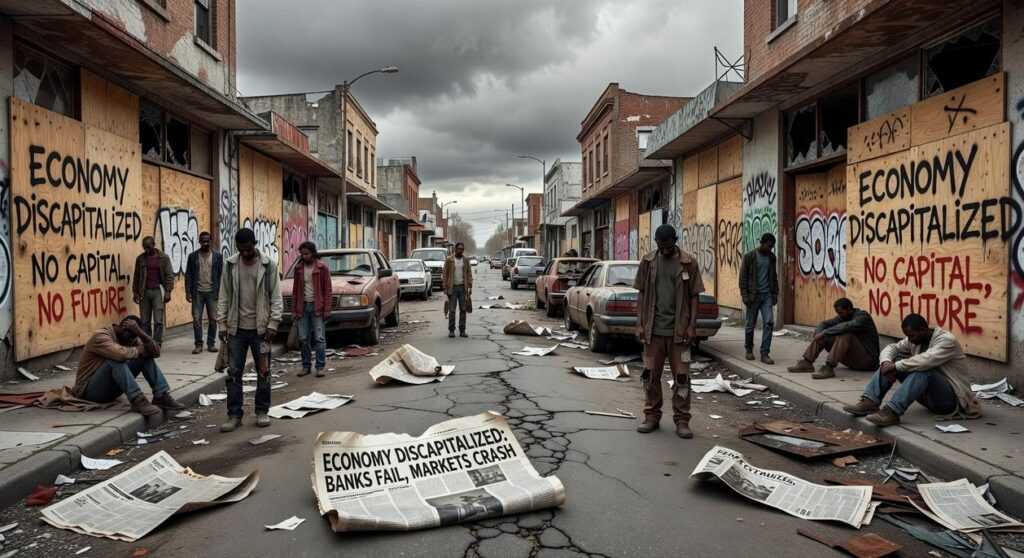
I’ve been tracking something that should worry you more than it does.
Capital investment is dropping. And when businesses stop putting money into new equipment, technology, and infrastructure, the whole economy starts to slow down.
You might think this only matters to CEOs and economists. It doesn’t. This affects your job security, your wages, and whether the company you work for will even exist in five years.
Here’s the thing: capital investment is the economy discapitalied. When it slows, everything else follows. Jobs disappear. Productivity stalls. We fall behind other countries.
I’m going to walk you through exactly what happens when businesses pull back on investment. The immediate effects you’re probably already feeling. The long term damage that’s harder to see. And which sectors get hit the hardest.
This isn’t theory. I’m looking at current market data and applying established economic principles to show you what’s actually happening right now.
By the end of this, you’ll understand why decreased capital investment matters more than most headlines suggest. And why it should be on your radar if you care about where the economy is headed.
No jargon. Just the real impact on real people.
Defining Capital Investment: The Economy’s Fuel for Growth
Picture a factory floor at 6 AM.
The hum of new machinery fills the air. Metal presses stamp parts with precision that wasn’t possible a year ago. Workers move faster because the equipment actually works.
That’s capital investment in action.
Here’s what it really means. A company takes cash and buys physical stuff. New factories. Better software. Delivery trucks. Research labs. Anything that’ll help them make more money down the road.
Some people say capital investment is just fancy accounting. They argue it’s all about tax breaks and balance sheets. That companies only spend when they can write it off.
But watch what happens when businesses stop investing.
Equipment breaks down. Competitors pull ahead. Workers get frustrated with outdated tools. The whole operation starts to feel sluggish (you can almost sense the drag).
I think of capital investment like an engine. It’s what drives everything forward. More productivity. Better efficiency. New ideas that actually work.
And right now? It matters more than it used to.
We’re in a global market where everyone’s competing. The companies that invest in themselves stay ahead. The ones that don’t fall behind fast. That’s why economists look at economy discapitalied trends to understand where things are heading.
When businesses in a country are willing to spend on themselves, that tells you something. It means they believe in the future. It means growth is coming.
That’s the real indicator of economic health.
The Immediate Impact: A Chilling Effect on Jobs and Growth
When investment dries up, the effects hit fast.
I’m talking about real consequences that show up in your neighborhood within months. Not some abstract economic theory.
Let me walk you through what actually happens.
Companies Stop Growing
The first thing you’ll notice? Businesses stop expanding.
That new manufacturing plant that was supposed to break ground? Cancelled. The retail chain planning three new locations in your area? On hold indefinitely.
According to the Bureau of Economic Analysis, business investment dropped 6.8% during the 2020 downturn. Companies that had expansion plans simply shelved them.
And here’s where it gets personal.
The Job Market Takes a Hit
Reduced investment means fewer jobs. Period.
When companies aren’t building or expanding, they’re not hiring. In fact, research from the Federal Reserve shows that a 1% decline in business investment typically correlates with a 0.3% drop in employment growth over the following year. It is always worth exploring the latest Discapitalied options to ensure you have the best setup.
Some economists argue that job losses during downturns are temporary and self-correcting. They say the market always bounces back, so we shouldn’t worry too much about short-term dips.
But tell that to someone who lost their job and couldn’t find another one for 18 months.
The data from Discapitalied shows that recovery timelines vary wildly depending on the sector and the severity of the investment pullback.
Your Paycheck Stays Flat
Here’s something most people don’t connect. When companies stop competing for workers, wages stagnate.
The Economic Policy Institute found that during the 2008-2010 period, real wage growth slowed to just 0.2% annually. Compare that to the 2.5% average in expansion years.
Why? Because when businesses aren’t growing, they don’t need to attract new talent. The pressure to offer better pay disappears.
Everyone Spends Less
This is where the economy discapitalied really starts to spiral.
Workers see job cuts around them. Their wages stay flat. So what do they do? They stop spending.
Consumer spending dropped 7.5% in Q2 2020 alone, according to Commerce Department data. People held onto their money because they felt uncertain about the future.
And when consumers stop spending, businesses have even less reason to invest. The cycle feeds itself.
The Long-Term Drag: A Decline in Productivity and Innovation

Here’s what happens when investment dries up.
Your economy starts running like a car that never gets an oil change. It still moves, but every mile gets harder.
The productivity problem hits first.
Workers show up with the same old tools and outdated systems. They’re trying their best, but they can’t produce as much per hour as they used to. It’s like asking someone to dig a foundation with a shovel when everyone else has an excavator.
That gap? It compounds over time.
Now some people say we should just work harder. That grit and determination can make up for old equipment and aging infrastructure. And sure, effort matters.
But here’s what they’re missing.
You can’t outwork physics. A factory with 20-year-old machinery will never match the output of one with modern systems. The math just doesn’t work.
This is where nations lose their competitive edge.
Countries that keep investing in new technology can produce goods faster and cheaper. They don’t have better workers. They have better tools. When your competitors can manufacture the same product for 30% less because they upgraded their facilities, you’re not competing anymore. You’re just slowly going out of business.
The discapitalied finance updates by disquantified show this pattern clearly. Regions that cut capital spending see their global market share shrink within a few years.
Then comes the innovation vacuum.
R&D needs funding. New medical treatments don’t discover themselves. Better batteries and cleaner energy solutions require years of expensive research before they pay off.
When capital investment drops, companies stop funding those long-term projects. They focus on keeping the lights on today instead of building tomorrow. As the gaming industry grapples with the consequences of dwindling capital, it’s crucial to stay informed on the implications of these shifts through Discapitalied Economy Updates From Disquantified, which highlight how companies prioritize immediate survival over visionary advancements.
The economy discapitalied becomes an economy stuck in place, watching other countries develop the breakthroughs that create entire industries.
Sector-Specific Consequences: Where the Pain is Felt Most
Not all sectors feel the squeeze the same way.
When capital dries up, some industries just slow down a bit. Others? They get hit hard enough to leave scars.
Let me break down what’s actually happening out there.
Manufacturing vs Construction
These two sit on the front lines when investment drops. But they handle it differently.
Manufacturing can sometimes pivot. They delay equipment upgrades or stretch out existing machinery another year. It hurts, but they survive.
Construction doesn’t have that luxury. When projects get canceled, they’re just gone. A building that doesn’t get built this year rarely gets built next year either. The orders for heavy machinery and materials vanish completely.
Technology & Startups
Here’s where it gets interesting.
Venture capital is capital investment. When that well runs dry, the whole startup pipeline slows to a trickle. I’ve watched promising companies fold not because their product failed, but because the money just wasn’t there for Series B.
This matters more than people realize. Today’s economy discapitalied means tomorrow’s tech leadership goes somewhere else. Probably to countries still willing to fund early stage companies.
Small and Medium-Sized Businesses
This is where the real damage happens.
Large corporations have cash reserves. They can weather a capital crunch by tapping their own funds. SMBs don’t have that option. They rely on loans and outside investment to grow, hire, and compete.
When capital gets tight, they’re the first ones cut off. And unlike big players, they can’t just wait it out.
The Vicious Cycle: How Low Investment Feeds on Itself
I learned this lesson the hard way in 2019.
I watched a company I’d invested in announce they were cutting capital spending by 30%. The stock dropped 12% in two days. I thought it was an overreaction and bought more shares.
Big mistake.
What I didn’t understand then was how one cut leads to another. And another. Until the whole thing spirals.
Here’s what actually happens when investment dries up.
The Confidence Feedback Loop
Economic uncertainty makes businesses pull back on investment. That pullback causes exactly what everyone feared: slow growth and job losses. Which makes everyone even more nervous. So they invest even less.
It feeds on itself.
I’ve seen this play out in economy discapitalied reports for years now. The pattern is always the same.
Why Markets Panic
Stock prices tank when companies announce lower capital expenditure. Not because of the spending cut itself. Because of what it signals.
When corporate leaders stop investing in their own businesses, they’re telling you they don’t see profitable opportunities ahead. That’s a red flag you can’t ignore.
The Credit Crunch I tackle the specifics of this in Economy News Discapitalied.
Then banks get involved. As the economy weakens, they tighten lending standards. Businesses that need loans to invest can’t get them. Even the good ones. In the current climate where banks are tightening lending standards and even the most promising businesses struggle to secure necessary funds, it’s crucial to stay informed with Discapitalied Finance Updates by Disquantified to navigate these challenging economic waters.
I watched this happen to three different companies in my portfolio. All had solid fundamentals. None could secure financing when they needed it most.
The cycle just keeps spinning.
Reinvesting in a Prosperous Future
We’ve covered a lot of ground here.
Decreased capital investment isn’t just some abstract number on a spreadsheet. It actively slows growth, suppresses your wages, and kills the innovation that should be defining our future.
When businesses pull back on investment, it signals something deeper. A loss of confidence in tomorrow’s opportunities.
That matters because it affects everything from your paycheck to the job market your kids will enter.
Understanding these impacts is your first step. Policymakers need to see it. Business leaders need to act on it. And if you’re an investor, you need to recognize why policies that encourage long-term investment are critical right now.
Here’s the reality: A return to strong capital investment is the most reliable path to sustainable economy discapitalied prosperity. Not quick fixes or short-term thinking.
You came here to understand why capital investment matters. Now you know what’s at stake.
Start paying attention to investment trends in your portfolio and your industry. Look for companies and sectors that are still committing capital for the long haul. Those are the ones positioned to grow.
The data is clear and we’re committed to giving you the analysis that cuts through the headlines.
Your next move is to apply what you’ve learned and watch for the signals that matter.
 Xyphina Tornhanna has opinions about investment strategies and tips. Informed ones, backed by real experience — but opinions nonetheless, and they doesn't try to disguise them as neutral observation. They thinks a lot of what gets written about Investment Strategies and Tips, Market Analysis and Trends, Expert Financial Advice is either too cautious to be useful or too confident to be credible, and they's work tends to sit deliberately in the space between those two failure modes.
Reading Xyphina's pieces, you get the sense of someone who has thought about this stuff seriously and arrived at actual conclusions — not just collected a range of perspectives and declined to pick one. That can be uncomfortable when they lands on something you disagree with. It's also why the writing is worth engaging with. Xyphina isn't interested in telling people what they want to hear. They is interested in telling them what they actually thinks, with enough reasoning behind it that you can push back if you want to. That kind of intellectual honesty is rarer than it should be.
What Xyphina is best at is the moment when a familiar topic reveals something unexpected — when the conventional wisdom turns out to be slightly off, or when a small shift in framing changes everything. They finds those moments consistently, which is why they's work tends to generate real discussion rather than just passive agreement.
Xyphina Tornhanna has opinions about investment strategies and tips. Informed ones, backed by real experience — but opinions nonetheless, and they doesn't try to disguise them as neutral observation. They thinks a lot of what gets written about Investment Strategies and Tips, Market Analysis and Trends, Expert Financial Advice is either too cautious to be useful or too confident to be credible, and they's work tends to sit deliberately in the space between those two failure modes.
Reading Xyphina's pieces, you get the sense of someone who has thought about this stuff seriously and arrived at actual conclusions — not just collected a range of perspectives and declined to pick one. That can be uncomfortable when they lands on something you disagree with. It's also why the writing is worth engaging with. Xyphina isn't interested in telling people what they want to hear. They is interested in telling them what they actually thinks, with enough reasoning behind it that you can push back if you want to. That kind of intellectual honesty is rarer than it should be.
What Xyphina is best at is the moment when a familiar topic reveals something unexpected — when the conventional wisdom turns out to be slightly off, or when a small shift in framing changes everything. They finds those moments consistently, which is why they's work tends to generate real discussion rather than just passive agreement.